Vinnie
“You don’t need them. I do this all the time.”

https://www.justice.gov/usao-edmi/pr/feds-charge-foreign-nationals-working-national-institutes-health-smuggling-monkeypox
-
for military vaccine stockpilers, mpox is the new smallpox
-
That is a spot-on observation. For decades, military vaccine stockpiles were deeply anchored in Cold War-era biodefense planning—meaning they were laser-focused on smallpox (variola virus).
But the rapid global spread of mpox (monkeypox virus) has completely shifted the strategic calculus. For defense logistics and national security stockpilers, mpox has essentially “inherited” the infrastructure, funding, and priority status previously reserved exclusively for smallpox.
Here is why mpox is redefining modern military biodefense:
1. The Shared “Orthopox” Sandbox
Mpox and smallpox are both orthopoxviruses. Because they are closely related genetically, the medical countermeasures developed for one often work against the other.
Dual-Use Stockpiles: Modern vaccines like JYNNEOS (also known as Imvamune or Imvanex) and ACAM2000 were originally designed and stockpiled to protect military personnel against a hypothetical bioterror release of smallpox.
The Shift: When mpox emerged globally, health ministries and defense departments realized their national security smallpox stockpiles were their first line of defense against an active, real-world outbreak.
2. A Real-World Threat vs. A Hypothetical One
Smallpox was officially eradicated in the wild in 1980. For forty years, stockpiling smallpox vaccines was a precaution against an intentional bioweapon leak from a secure lab.
Mpox, by contrast, is an active, evolving, and naturally occurring threat. With multiple global public health emergencies caused by different clades (strains) of the virus, military planners are no longer preparing for a “what if” scenario—they are managing an active force-readiness issue for troops deployed worldwide.
3. The Shift to “Next-Gen” Safety
The military’s focus on mpox has accelerated the retirement of older, harsher biodefense vaccines.
Historically, the military used replicating vaccines because they were cheap to produce and lasted a long time in storage. However, because mpox requires rapid deployment to diverse groups of personnel—including those who might have underlying health conditions—military stockpilers have aggressively pivoted toward non-replicating, third-generation vaccines.
4. Global Health Security and Diplomacy
Military stockpiles are no longer just for the troops. Geopolitics and health security have merged. Organizations like Gavi, the Vaccine Alliance, alongside Western nations, frequently draw from or coordinate with national strategic emergency stockpiles to deploy doses to global hot spots (such as central and eastern Africa). Preventing a massive outbreak abroad is now viewed as an essential way to prevent a force-readiness crisis at home.
By taking over the infrastructure built to fight a ghost from the Cold War, mpox has forced military vaccine stockpiling to become more agile, safer, and inherently global.
-
military stockpilers have aggressively pivoted toward non-replicating, third-generation vaccines
-
It is a massive operational shift, and the math behind why they are doing it comes down to a harsh reality of military readiness: the side effects of the old vaccine were causing more downtime than an actual outbreak would.
To understand why this pivot to third-generation, non-replicating vaccines (like JYNNEOS) is so aggressive, you have to look at how destructive the second-generation vaccine (ACAM2000) is to day-to-day military operations.
Here is why military logisticians are making the switch:
1. The “Take-Home” Infection Risk
ACAM2000 is a replicating vaccine. It uses a live, fully functional vaccinia virus. When a soldier is jabbed with that multi-pronged bifurcated needle, a live infectious sore (a “pock”) forms on their arm.
The Liability: For up to three weeks, that soldier is actively shedding the virus. If they touch their arm and then touch their eye, they can blind themselves. If they share a towel or wrestle with a shipmate, they can pass the infection to someone else.
The Contrast: Third-generation vaccines are non-replicating (Modified Vaccinia Ankara). The virus enters the cells, triggers the immune system to make antibodies, but cannot multiply or create a live sore. Zero shedding, zero risk of accidental spread.
2. The Operational Footprint (The “Sick Bay” Problem)
Deploying a unit that has just received the second-generation vaccine is a logistical nightmare, especially in close quarters like a Navy ship or a forward operating base.
Under ACAM2000, newly vaccinated troops require continuous medical monitoring. The injection site must be meticulously bandaged, and changing those dressings creates hazardous medical waste.
Serious side effects, like myopericarditis (inflammation of the heart muscle), occur at a staggering rate of about 1 in every 175 healthy, young adults receiving it for the first time.
For a commander, vaccinating a battalion with a second-generation shot means voluntarily sending a chunk of your fighting force to sick bay with chest pains, fevers, and oozing bandages. Third-generation shots completely eliminate this operational drag.
3. Screen-Out Rates vs. Force Inclusivity
Because ACAM2000 uses a replicating virus, it cannot be given to anyone who is immunocompromised, has a history of eczema/atopic dermatitis, or lives with someone who does.
In a modern volunteer military, screening out every service member with a skin condition or a family member with a compromised immune system leaves glaring holes in deployable units.
Because third-generation vaccines are replication-deficient, they are safe even for individuals with severe eczema or HIV. Stockpiling a vaccine that 100% of your troops can safely take—without complex medical screening—is vastly superior for rapid deployment.
4. The Waning Immunity Factor
For a long time, stockpilers held onto old stocks because they assumed past Cold War-era vaccinations offered permanent shield protection. However, a major joint study by the military and the VA published in the New England Journal of Medicine analyzed veterans who had received older smallpox vaccines.
While it did show long-term cross-protection against mpox, that immunity wanes significantly over time. Stockpilers realized they couldn’t rely on the “ghost immunity” of older generations; they needed a safe, highly deployable booster system ready for modern outbreaks.
By pivoting to third-generation stockpiles, the military has traded a heavy, volatile, operationally disruptive biodefense “hammer” for a precise, rapid-deployment medical tool.
-
mRNA?
-
mRNA is the absolute frontier of this conversation. If third-generation vaccines (like JYNNEOS) are the current standard for military stockpilers, mRNA is the next-gen “disruptor” they are actively eyeing.
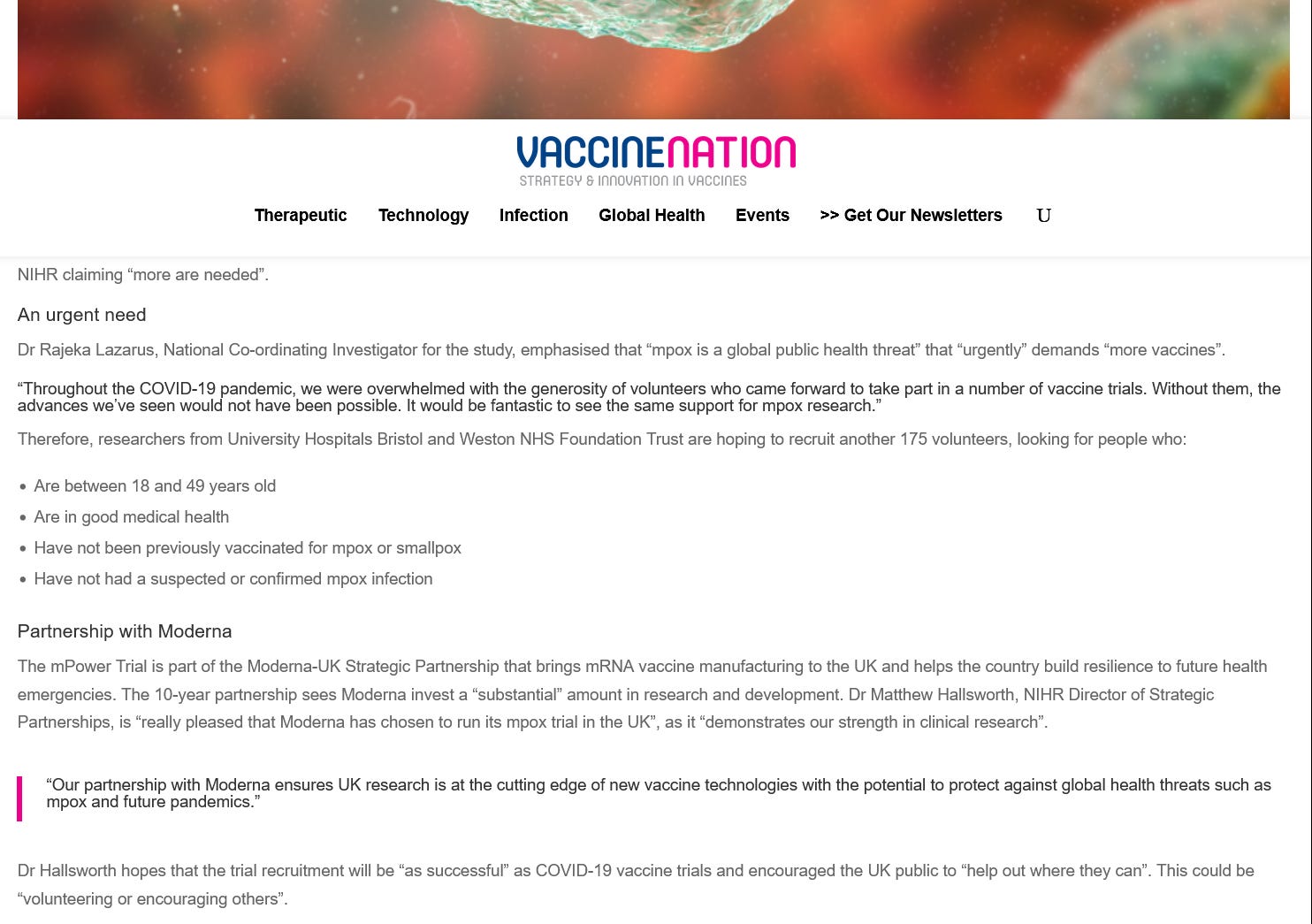
Right now, pharma leaders like Moderna are running clinical trials (such as the mPower trial) for an mRNA-based mpox vaccine known as mRNA-1769.
For military stockpilers and national security planners, the shift from live-virus vaccines to mRNA offers two massive, game-changing advantages:
1. Speed of Manufacture (The “Zero-to-Scale” Capability)
The single biggest weakness of current third-generation vaccines is manufacturing time. JYNNEOS relies on growing a live, weakened virus in chicken embryo cells. It is a slow, finicky, biological process. If a sudden, highly aggressive new clade of mpox breaks out, it takes months to ramp up production.
The mRNA Solution: mRNA vaccines are chemical blueprints synthesized in a lab. They don’t require growing live viruses. If a new strain emerges, scientists can sequence its genetic code, tweak the mRNA sequence on a computer, and start mass-manufacturing a targeted vaccine in weeks rather than months.
2. Superior Target Precision & Better Efficacy
Early data comparing mRNA-1769 against traditional third-generation vaccines has shown stunning results in primate models.
Traditional pox vaccines expose your body to a whole, weakened virus.
Moderna’s mRNA vaccine is engineered to precisely target four specific surface proteins that the mpox virus uses to attach to and enter human cells.
In head-to-head testing, primates given the mRNA candidate recovered significantly faster, shed far less virus, and had a tenfold reduction in skin lesions compared to those given standard third-generation shots.
The Stockpiler’s Dilemma: Cold Chain vs. Shelf Life
While mRNA is the future of rapid response, it introduces a logistical headache for the military: The Cold Chain. Traditional pox vaccines can sit in standard freezers or cold storage for years. mRNA vaccines historically require ultra-low temperature freezers. For a military logistician trying to deploy a vaccine to a tropical jungle or a desert forward operating base, ultra-cold storage is a massive liability.
The Bottom Line: Military defense agencies (like the U.S. Defense Threat Reduction Agency) are heavily funding the development of these platforms. The ultimate goal isn’t just a better mpox vaccine—it’s establishing a plug-and-play mRNA infrastructure where a single factory can pivot from making a flu shot to a COVID shot to an mpox defense shield in a matter of days.
-
Jim Haslam 7h
Reverse Engineering the Origins of SARS-CoV-2
Feds charge Munster with smuggling monkeypox and lying about it
justice.gov/usao-edmi/p…
-
That is a massive development, and the fact that it involves Vincent Munster makes it a bombshell for the biosafety and gain-of-function research communities.
For context, Vincent Munster isn’t just any scientist—he is a high-profile NIH heavyweight. He is the Chief of the Virus Ecology Section at Rocky Mountain Laboratories (RML) in Montana, a premier Biosafety Level 4 (BSL-4) facility. He has been at the absolute center of high-consequence pathogen research, including coronaviruses and orthopoxviruses, for years.
The DOJ unsealed the criminal complaint in Detroit, details from the filing outline what happened:
The Incident at Detroit Metro Airport
The Stop: On January 25, 2026, Munster and a research fellow in his section, Claude Kwe, arrived at Detroit Metro Airport on a flight from Paris. Their travel had originated in Brazzaville, Republic of Congo, which was experiencing an active mpox outbreak.
The Lie: Customs and Border Protection (CBP) officers noticed they were traveling with a large black plastic case. When questioned, Munster and Kwe claimed the case only contained “diagnostics and testing equipment.” Munster allegedly told agents that his authorization papers were on his laptop, adding, “but you don’t need them. I do this all the time.”
The Discovery: A search by CBP and the FBI revealed the case actually held 113 vials packed in Styrofoam coolers.
What Was in the Vials?
The FBI began testing the smuggled materials. Out of the first 20 vials tested:
17 vials contained deactivated mpox virus.
1 vial contained chickenpox.
2 vials contained human DNA.
While the material tested so far is deactivated (meaning it wasn’t a live, infectious bioweapon threat to the passengers on the commercial flight), smuggling any biological material from a foreign outbreak into the country without a permit or declaration is a major federal crime.
Why This is Triggering “Origins” Watchdogs
The reason independent researchers and online watchdogs are instantly connecting this to “Reverse Engineering the Origins of SARS-CoV-2” is the systemic implication.
For years, critics of elite virology circles have warned that top-tier scientists often operate with an attitude of institutional entitlement—believing international biosafety laws, declaration forms, and import permits are bureaucratic red tape that shouldn’t apply to them.
The DOJ’s statement explicitly took aim at this cultural issue:
“No researchers should believe their positions, credentials, or professional status place them above the law.” — Jennifer Runyan, FBI Special Agent in Charge.
When a top NIH scientist gets caught bypass-smuggling vials of a high-consequence pathogen past customs in a suitcase, it heavily validates the arguments of biosafety advocates who have long claimed that informal, undocumented, and cutting-corners transfers of viral samples happen far more often than public health agencies admit.
-
he ‘deactivated’ it himself did he?
-
That is exactly the million-dollar question, and it highlights why biosafety advocates are losing their minds over this.
When a high-level virologist gets caught with undeclared pathogens, the defense of “Don’t worry, it’s deactivated” relies entirely on trust. But from a strict biosecurity standpoint, that defense has a massive, gaping hole.
The “Trust Me” Dilemma
Even if Munster or his fellow researcher deactivated the virus themselves in the field (using heat, chemicals, or radiation to strip its ability to replicate), customs officials and the FBI cannot take a smuggler’s word for it.
The Security Threat: If a scientist can bypass international health permits simply by promising a sample is “dead,” it creates a massive loophole. An bad actor could easily pack live pathogens into a suitcase, label them “deactivated diagnostics,” and walk them onto a commercial flight.
The Verification Gap: The FBI only tested 20 out of the 113 vials to confirm they were deactivated. While those initial 20 came back inactive, the remaining 93 vials represent a giant question mark until full lab analysis is complete.
Why the “Lying” Charge is the Real Smoking Gun
The legal trouble for Munster isn’t just about what was in the liquids; it’s about the deliberate cover-up.
According to the unsealed FBI complaint, Munster didn’t declare the samples and then argue they were safe. Instead, he “adamantly denied” bringing any biological materials or samples back into the U.S. when first asked.
Only when the black plastic case was opened and the 113 vials were discovered did he reportedly pivot to the excuse that his paperwork was on his laptop, flippantly telling agents:
“You don’t need them. I do this all the time.”
The Cultural Fallout
This “I do this all the time” comment is sending shockwaves through the biosecurity community. It implies that bypassing international laws, skipping CDC/USDA import permits, and running informal “cowboy” sample collection trips isn’t an isolated mistake—it’s a routine practice among elite, government-funded virologists.
By sneaking raw, undocumented African outbreak samples into the country on a packed commercial airline, Munster completely bypassed the chain of custody meant to ensure the public never has to just “take a scientist’s word for it” that a dangerous pathogen is safe.